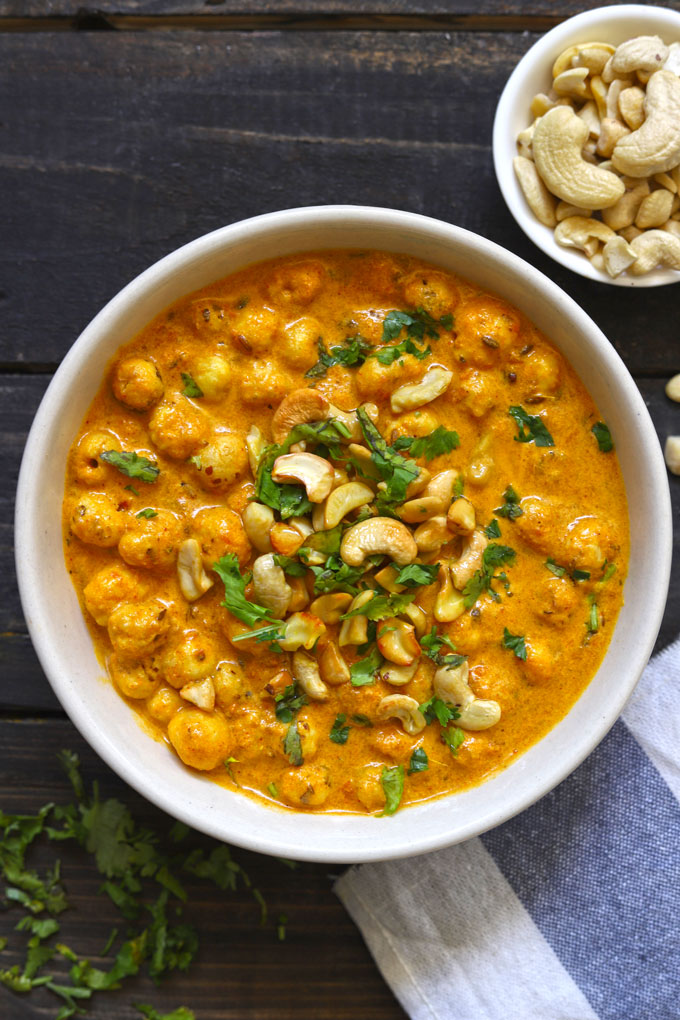
Phool Makhana Curry is a vegetarian Indian curry made with foxnuts without using onion and garlic. It is a delicious way to include foxnuts in a Navratri or Janmashtmi meal.
Estimated reading time: 3 minutes
- The Foxnut (Lotus Seeds)
- Recipe Variations
- Watch Makhana Sabzi Video
- Serving Suggestion
- My Tried and True Tips
- Phool Makhana Curry Recipe
The Foxnut (Lotus Seeds)
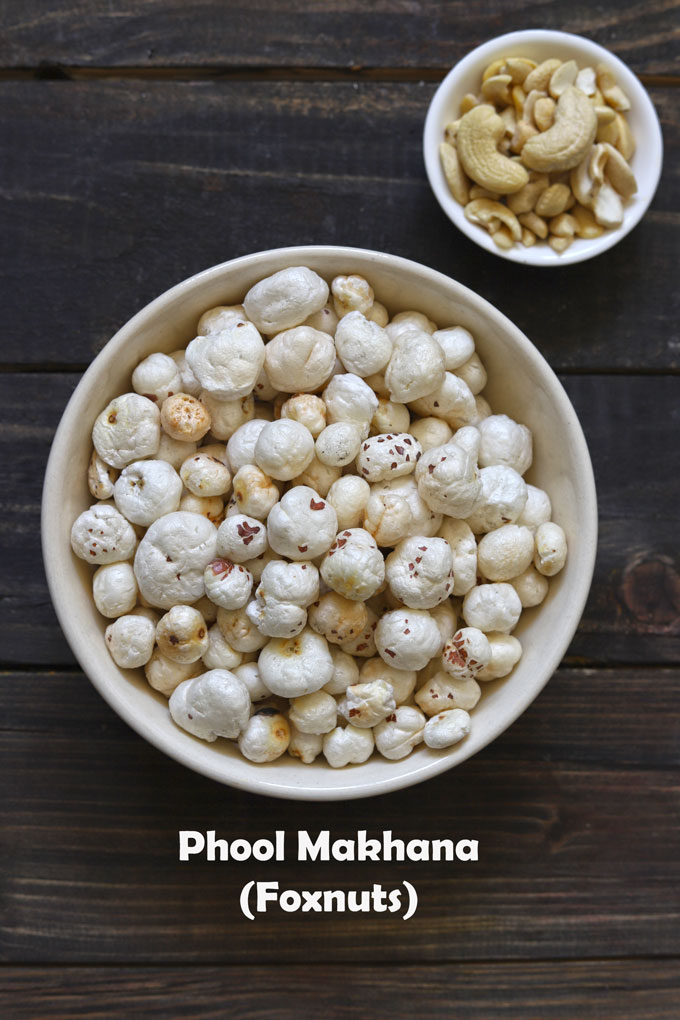
The phool makhana is known as lotus seeds or foxnuts. They are produced in India, Korea, and Japan. Today foxnuts are considered an excellent low-calorie, anti-oxidant, gluten-free, vegan superfood.
They are commonly used to make kheer , phirni , munching snacks , curry, and caramel makhana . Regarding Hindu religion festive feasts or fasting recipes, foxnuts are a popular ingredient.
The phool makhana curry is a unique, easy, and delicious Indian curry. Even if you are not fasting, this makhana sabzi adds a great variety to the everyday meal menu . The roasted foxnut and the cashews make it a rich and creamy curry.
Recipe Variations
There are many variations of phool makhana curry. A few of the popular ones are:
- Kaju Makhana Sabzi: This version has a rich, creamy gravy made with cashew paste. Also, you can add ghee-fried cashews to the curry.
- Matar Makhana Sabzi: You can make phool makhana curry in a methi matar malai style with onion and garlic-based sauce.
- Masala Makhana Sabzi: It is a true Punjabi-style curry made in onion and tomato masala with spices.
However, you can substitute paneer with foxnuts in Indian curry recipes.
Watch Makhana Sabzi Video
Serving Suggestion
Serve phool makhana curry with poori or palak puri , kuttu puri , mint raita , and a simple side dish such as khatta meetha kaddu or masala potato fry for a wholesome no onion, no garlic meal.
This kind of sattvic meal combination leaves a delicate trail of flavours in the taste buds and, at the same time, gives you a soul-satisfying experience.
My Tried and True Tips
- The roasting of foxnuts (makhana) in ghee makes them crisp and crunchy. Hence, do not add them without roasting them in the gravy.
- The foxnut absorbs liquid once added to the gravy, making it slightly thick. Hence, adjust the consistency of the gravy accordingly.
- Add cashews and foxnuts a few minutes before serving the phool makhana curry. This way, roasted foxnuts will not become chewy or soggy.
- If you prefer, add ½ teaspoon of homemade garam masala to the makhana curry for the aroma and flavour.

More No Onion No Garlic Recipes
- Paneer Butter Masala
- Pahadi Aloo Gutke
- Masala Potato Fry
- Dahi Potato Curry
- Chana Masala
- Panchmel Dal
- Aloo Ki Sabzi
- Arbi Ki Sabzi
More no onion no garlic recipes for your everyday Indian meal.

Ingredients
- ▢ 2 Cup foxnut (phool makhana/lotus seed)
- ▢ 1 Cup tomato, chopped
- ▢ 1 green chili
- ▢ 1 tablespoon giner, chopped
- ▢ 4 tablespoon ghee
- ▢ ¼ Cup unsalted cashew
- ▢ 1 teaspoon cumin seeds (jeera)
- ▢ ¼ teaspoon asafoetida (hing)
- ▢ Salt to taste
- ▢ ½ teaspoon turmeric powder
- ▢ ½ teaspoon red chili powder
- ▢ 2 tablespoon cream (malai or fresh cream)
- ▢ ¼ Cup water
- ▢ 1 tablespoon chopped fresh coriander
Instructions
- Combine chopped tomato, green chili, and ginger. Make a smooth puree in the blender using 1 – 2 tablespoons of water. Set aside.
- Heat 2 tablespoons of ghee in a kadhai. Fry the foxnuts (makhana) until crisp. Keep stirring while roasting. Transfer to a plate. In the same kadhai add cashews and fry till they turn light golden in color. Transfer to a plate and set aside.
- Heat the remaining ghee in the same kadhai. Add cumin seeds and asafoetida. Fry for 10 – 20 seconds. Next, add the tomato masala and fry the masala over low heat. Add the spices, salt, and cook till the oil starts separating from the tomato masala.
- Add the cream and stir to combine nicely. Now add this stage if you like to make little gravy add approximately ¼ Cup of water. Stir to mix and simmer the curry over low heat for 5 – 6 minutes.
- Add the roasted foxnut and cashew, stir to combine nicely. Cook for 2 – 3 minutes. Turn off the heat. Garnish with chopped coriander and cream.
- Serve Phool Makhana Curry with poori .
Recipe Notes:
Nutrition
We follow a strict NO SPAM Policy

Phool Makhana Curry Recipe
Equipment
- Heavy Bottom Kadhai
Ingredients
- 2 Cup foxnut (phool makhana/lotus seed)
- 1 Cup tomato, chopped
- 1 green chili
- 1 tablespoon giner, chopped
- 4 tablespoon ghee
- ¼ Cup unsalted cashew
- 1 teaspoon cumin seeds (jeera)
- ¼ teaspoon asafoetida (hing)
- Salt to taste
- ½ teaspoon turmeric powder
- ½ teaspoon red chili powder
- 2 tablespoon cream (malai or fresh cream)
- ¼ Cup water
- 1 tablespoon chopped fresh coriander
Instructions
- Combine chopped tomato, green chili, and ginger. Make a smooth puree in the blender using 1 - 2 tablespoons of water. Set aside.
- Heat 2 tablespoons of ghee in a kadhai. Fry the foxnuts (makhana) until crisp. Keep stirring while roasting. Transfer to a plate. In the same kadhai add cashews and fry till they turn light golden in color. Transfer to a plate and set aside.
- Heat the remaining ghee in the same kadhai. Add cumin seeds and asafoetida. Fry for 10 - 20 seconds. Next, add the tomato masala and fry the masala over low heat. Add the spices, salt, and cook till the oil starts separating from the tomato masala.
- Add the cream and stir to combine nicely. Now add this stage if you like to make little gravy add approximately ¼ Cup of water. Stir to mix and simmer the curry over low heat for 5 - 6 minutes.
- Add the roasted foxnut and cashew, stir to combine nicely. Cook for 2 – 3 minutes. Turn off the heat. Garnish with chopped coriander and cream.
- Serve Phool Makhana Curry with poori .
Video
Notes
Nutrition
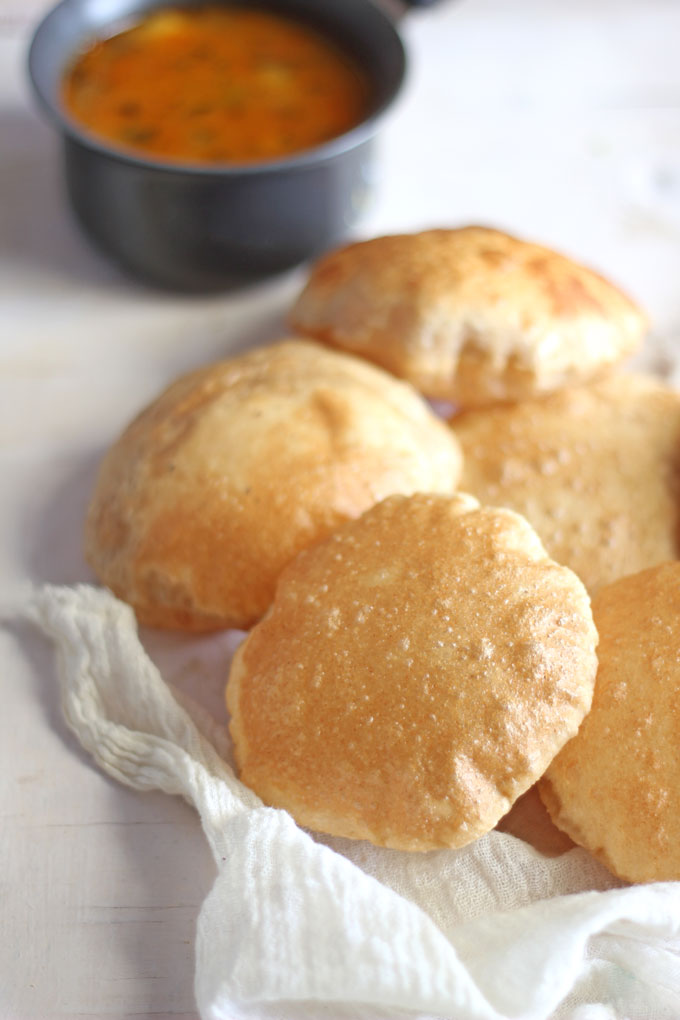
This is a tried and tested failproof whole wheat (atta) puri recipe that will help you to make perfect poori each time.
Estimated reading time: 6 minutes
- What is ‘Puri’?
- Ingredients You’ll Need
- The Poori Dough
- Secret of Fluffy and Crispy Puri
- Watch Puri Recipe Video
- Serving Suggestion
- My Tried and True Tips
- Whole Wheat Puri Recipe
What is ‘Puri’?
Puri or Poori is a deep-fried puffed-up Indian bread made with whole wheat flour (atta), salt, water, and oil. They are the most popular Indian side dish to accompany curries and gravy dishes.
Puri is always considered symbolic of the festive Indian meal . There is a kind of unsaid indulgence involved when we talk about poori.
The culinary tour of the country is never considered complete without enjoying Puri dipped in hot and bold curries.
Difference between Poori and Bhatura
Poori and Bhatura, are both deep-fried puffed-up Indian bread. But poori is made with whole wheat flour and is smaller in size. Whereas, Bhatura is made with an all-purpose flour fermented dough. It is of a big melon size and much thicker than a poori.
Ingredients You’ll Need
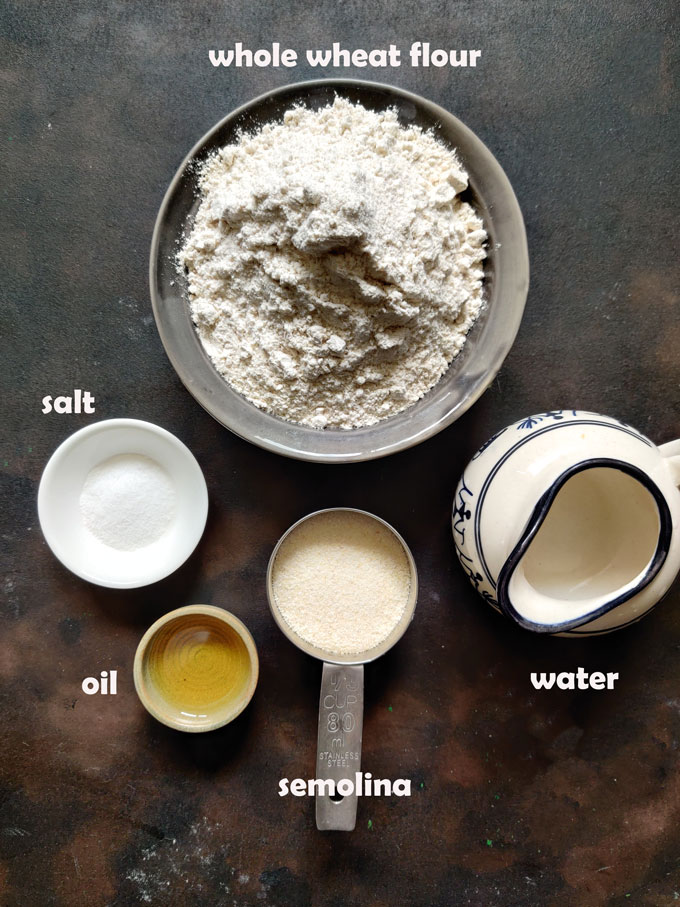
- Whole Wheat Flour is the key ingredient to make traditional atta poori.
- Semolina (Rava/Sooji) to give poori a crisp texture and to avoid oil-soaked poori.
- Salt gives flavour to the poori and increases shelf life.
- Water at room temperature is required to bind the dough. Many puri recipes suggest using milk for making the dough.
- Oil with a high smoking point, with a neutral taste is best for deep-frying poori. You can use ghee as well for a rich and indulgent flavour.
Puri Recipe Variations
Here are a few popular puri recipe variations for you to try:
- Ajwain Poori: Also known as namak ajwain poori, in this variation, a teaspoon of ajwain (carom seeds/omam) is added to the dough for a spicy, earthy flavor.
- Methi Poori: The addition of fresh fenugreek leaves or kasuri methi (dry fenugreek leaves) in the dough makes poori all the way more delicious.
- Masala Poori: From red chilli, to cumin seeds, you can flavour poori dough with any of your favourite spices.
- Luchi: In West Bengal, the poori is prepared with all-purpose flour known as Luchi or loochi.
The Poori Dough
As I mentioned above, making perfectly puffed-up soft Poori at home is no uphill task. The one thumb rule I learned from my mother about making perfect puri, is to get the dough right .
Knead
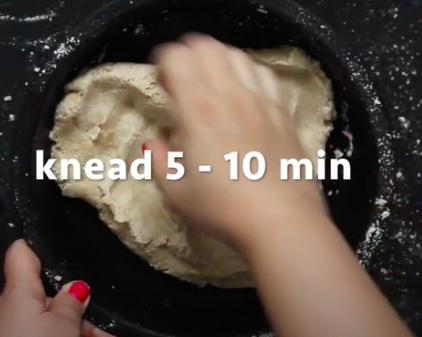
Texture: The dough for poori should be smooth, soft, pliable, yet firm to the touch. It should never be too soft, moist, or sticky.
Kneading: Like any other unleavened bread, the dough for puri requires a good amount of kneading of 5 – 10 minutes to get the right texture. Adding more water will never get you the desired result. A good kneading time and minimal water use are ideal for preparing the poori dough.
Resting: Once the dough is ready, give it a resting time of 15 – 20 minutes. At this stage, you can keep it in the fridge and in an airtight container to use later.
Secret of Fluffy and Crispy Puri
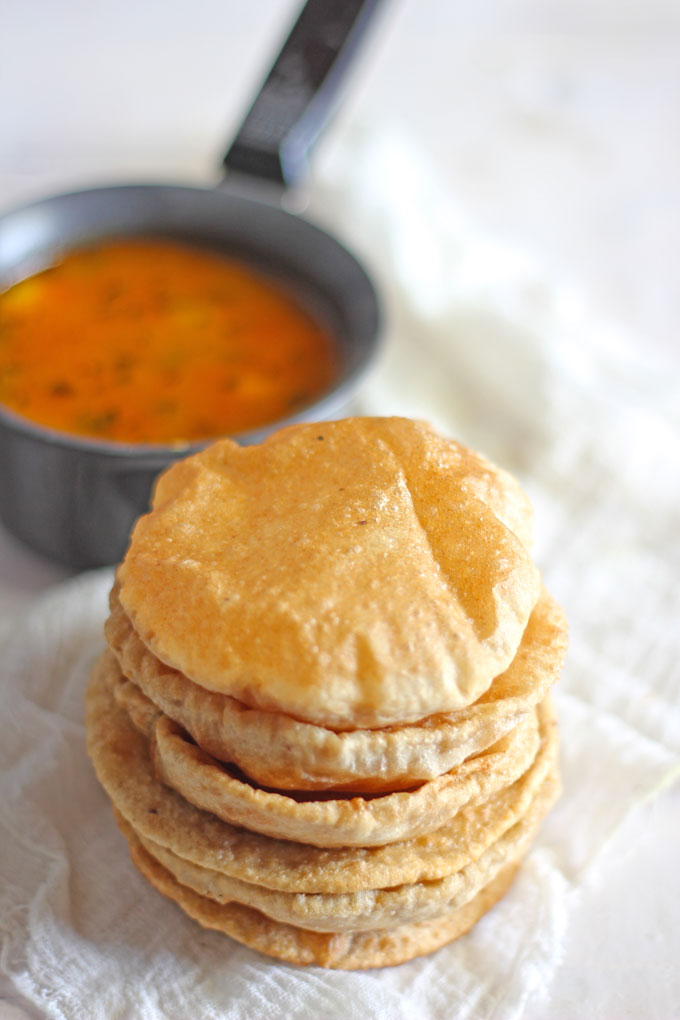
The rightly puffed-up puri swimming in hot oil is a big achievement.
Here are a few of my secret tips (which I learned from my mother) to make fluffy and crispy puri:
- The thickness of the puri should be even. A too-thin or thick poori might refuse to puff up and is likely to soak up too much oil while deep-frying.
- Heating oil to the right temperature is a crucial step. Keep moderating the heat while deep-frying poori to adjust the oil temperature.
Perform Test: drop a pinch of poori dough into the hot oil. The oil has reached the desired temperature if the dough floats to the surface within a few seconds. If it sinks to the bottom of the pan, then the oil has not reached the desired temperature for deep-frying.
- Once the poori is added to the hot oil, press it gently using a slotted spoon. This helps in puffing up the poori.
- Last, always use a wide and heavy bottom pan to deep-fry the poori.
Watch Puri Recipe Video
Serving Suggestion
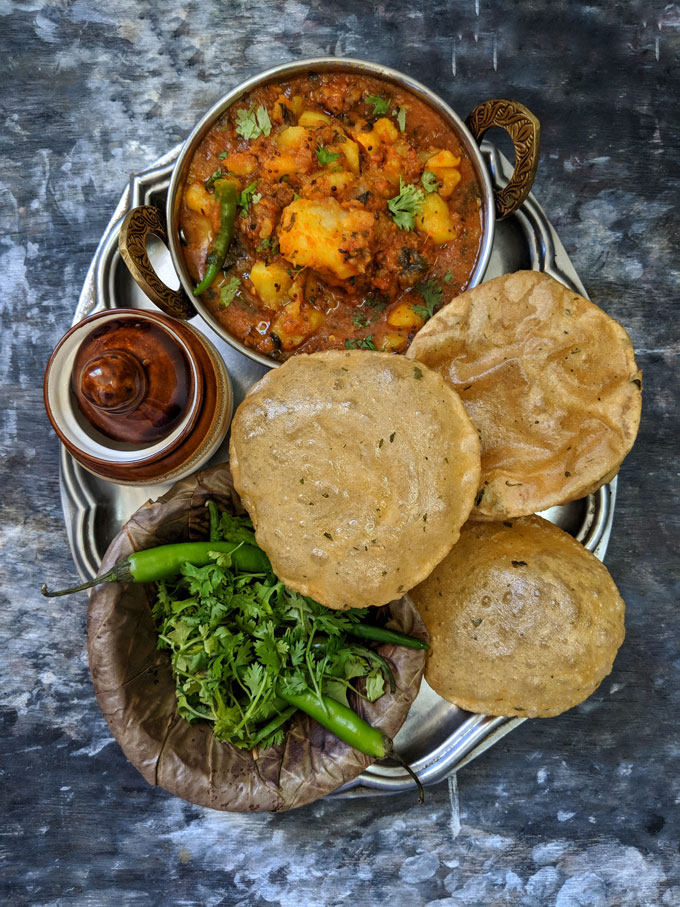
Usually, the most popular festive feast is poori and aloo ki sabzi or poori with jeera aloo . If you travel across North India, then chana – poori or chole – poori is also a widely loved meal combination
On the occasion of Navratri or Janmashtami, poori is served with no onion and no garlic curries like arbi ki sabzi , dahi aloo curry , or phool makhana curry
We Kumaoni like to savor poori with Pahadi Aloo Ke Gutke , and cucumber raita for an indulgent breakfast or brunch.
To store leftover puri , stack them and wrap them tightly in aluminium foil. Store them in an airtight container at room temperature for 1 – 2 days.
My Tried and True Tips
- Poori is too oily because the dough is too soft and sticky. Adding semolina to the dough helps in giving poori a crisp texture and makes them less oily.
- Poori is not crisp because the oil is not heated to the right temperature while frying.
- Poori is chewy because it is undercooked or not fried at the right temperature. Keep moderating the heat while deep-frying poori to adjust the oil temperature.
More Indian Poori Recipes
- Kutti Ki Puri
- Aloo Palak Puri
- Meethi (Sweet) Puri
- Masala Cheese Puri

Ingredients
- ▢ 2 Cup whole wheat flour (gehun atta)
- ▢ ¼ Cup semolina (sooji/rava) sooji
- ▢ 1 teaspoon salt
- ▢ 2 tablespoon refined oil
- ▢ ½ Cup water, at room temperature
- ▢ 4 Cup refined oil or ghee for deep frying
Instructions
- To prepare the dough for puri, first, sift the flour in a large bowl. Add salt and semolina in the flour. Mix nicely.
- Add 2 tablespoon oil to the flour mixture. Rub and mix using fingers.
- Now using 2 tablespoons of water at a time bring the flour together to form a dough.
- Make sure not to use too much water. We need firm yet pliable dough. If the dough is on a stiff side do not worry by kneading you can make it soft.
- Knead dough for next 5 – 10 minutes, more you need more soft puris would be. The good kneading time is one of the tricks to best puris.
- Rub the poori dough with a teaspoon of oil. Cover with a muslin cloth and let it rest for the next 15 – 20 minutes or so.
- Now heat oil for frying puris in a deep heavy bottom pan over medium heat.
- Divide the dough into small or medium size pieces.
- Shape each piece into a round ball by rolling in between your palms. Similarly prepare the balls from remaining dough.
- Before rolling out Poori grease rolling pin and surface with a teaspoon of cooking oil.
- Roll out one ball at a time into a small and thin circle. The size of the puri should be small to medium. Make sure not to roll it out too thin or thick.
- Once the oil is sufficiently hot then test by adding a pinch of dough. If it floats to the surface, the oil is sufficiently hot.
- Add one poori at a time and fry gently pressing down with the frying spoon or slotted spoon in a circular motion.
- Turn over when puffed up and fry the poori till golden brown on both sides. Transfer puri to a plate lined with a paper napkin.
- Serve Poori hot with aloo ki sabzi .
Recipe Notes:
- The plain water at room temperature is required to bind the dough.
- A flavorless refined oil with a high smoking point is best when it comes to deep-frying poori.
- The dough for poori should be smooth, soft, pliable yet firm to touch. It should never be too soft, moist, or sticky.
- You can store puri dough for a week in the refrigerator. Leave it at room temperature for 5 – 10 minutes to soften a bit before making poori.
- The thickness of the puri should be even. A too thin or thick poori might refuse to puff up and likely to soak up too much oil while deep – frying.
- Once the poori is added in the hot oil, press it gently using a slotted spoon. This helps in puffing up the poori.
- To store leftover puri , stack them and wrap tightly in aluminum foil. Store them in an airtight container for 1 – 2 days at room temperature.
Nutrition
We follow a strict NO SPAM Policy
