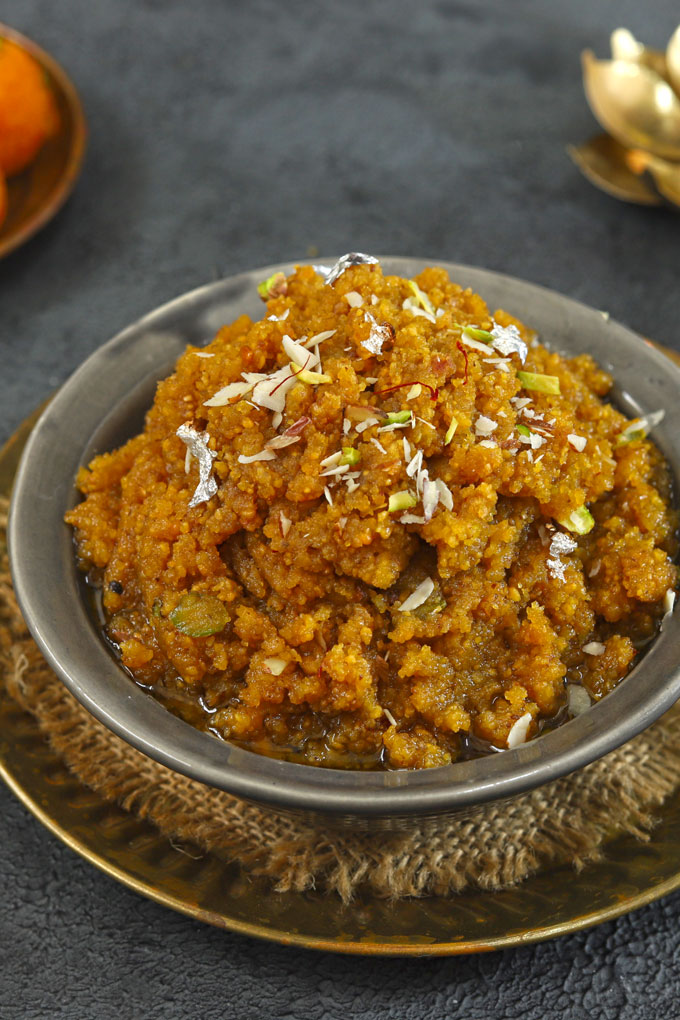
Here is an easy moong dal halwa recipe you can make from scratch without spending hours in the kitchen. Be sure to watch the video!
Estimated reading time: 4 minutes
- What is ‘Moong Dal Halwa’?
- Ingredients You’ll Need
- Watch Dal Halwa Video
- My Tried and True Tips
- Moong Dal Halwa Recipe
What is ‘Moong Dal Halwa’?
Halwa is an Indian sweet dish. It is an eggless, purely vegetarian sweet pudding. The dish is inspired by the Persian dessert called halvah . There are a variety of halwa variants popular across the Indian subcontinent. Moong Dal halwa is one of them.
The two words that come to my mind while talking about dal halwa are – patience and practice.
It is one of those Indian desserts that require a lot of patience to make and a fair understanding of the cooking process.
My Dal Badam Halwa Recipe is perfect for home cooks to make a delicious bowl of dessert without sweating in the kitchen for hours or ending up with a sore arm.
- perfect dessert for festive occasions
- protein-rich and gluten-free
- no artificial colours/flavours
- easy-to-follow halwa recipe
- requires pantry staples
- meal prep friendly
Ingredients You’ll Need
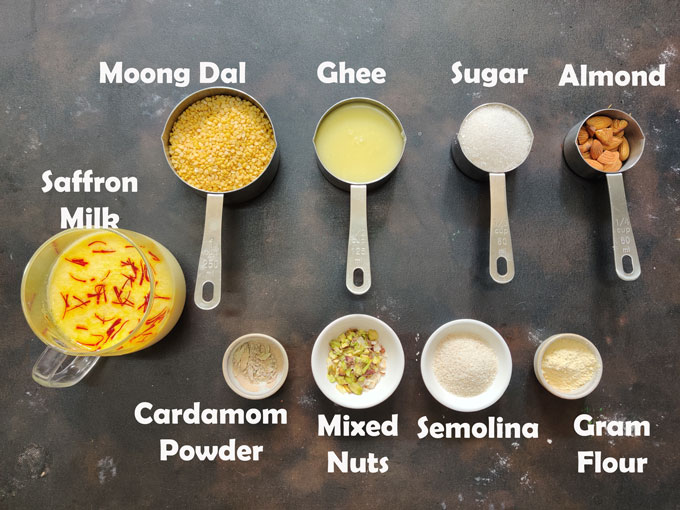
A few Indian pantry staples required for the dal halwa recipe are:
- Dal: The yellow mung (moong) dal is the key ingredient. Use dry, uncooked moong dal for this halwa recipe.
- Ghee: It is the soul of moong dal halwa. The good fat of ghee balances the protein of lentils. There is no way to skim or skip ghee in the halwa recipe.
- Almond: It gives a nutty and delicious mouth feel to the halwa. Plus increases its protein value.
- Gram Flour and Semolina: One tablespoon of each gives a perfect texture to the halwa and makes it easy to roast the dal powder.
- A full-fat milk , preferably with cream (malai) is the ideal choice. While slow roasting, the full cream milk turns into khoya (mawa).
- Granulated white sugar to sweeten the halwa. The brown sugar or jaggery powder does not do justice to the dal halwa taste and texture.
- Saffron and Green Cardamom
There are two ways of making this moong dal halwa.
Method 1 – make a wet paste of dal
- My Verdict: I find this method a bit tedious, time taking, and tricky. The wet paste took one hour to reach the desired texture and colour before adding milk. Plus, continuously frying wet paste requires a lot of muscle power. Hence, I am not a big fan of spending nearly 2 hours in the kitchen for a single dessert bowl.
Method 2 – make a dry powder of dal
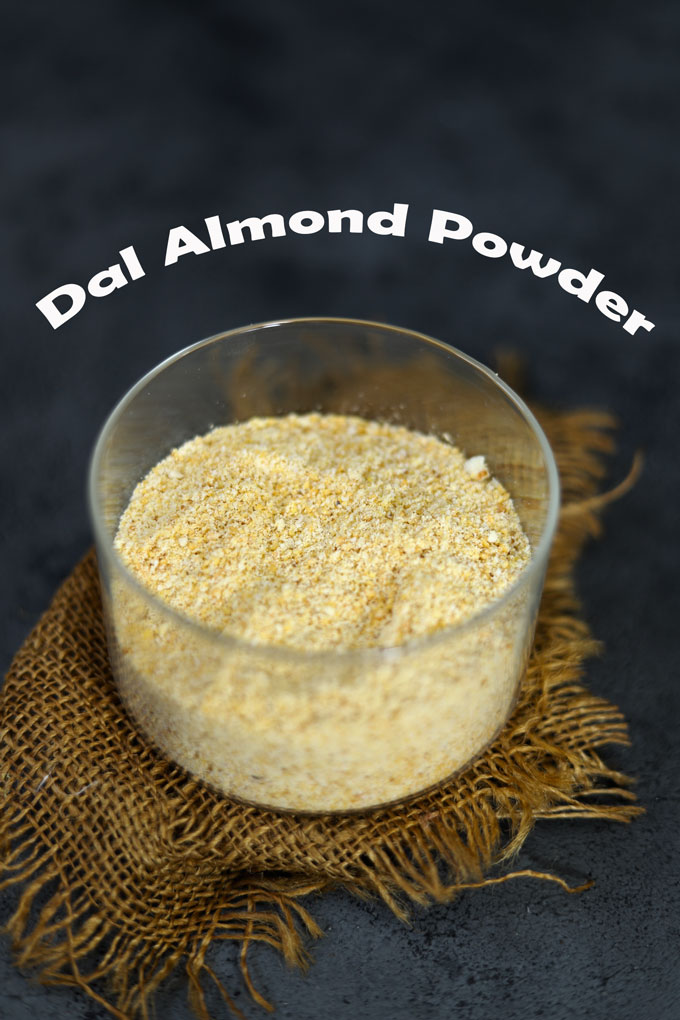
- My Verdict: This is my favourite way to make dal halwa. It requires less time and muscle power. The roasted dal powder is meal-prep friendly. You can store it for 1 – 2 weeks at room temperature. No need to start each time from scratch by soaking the dal and making a paste. Simply grab the dal powder and start making halwa.
Watch Dal Halwa Video
My Tried and True Tips
- Be Patient : Moong Dal Halwa is a labour of love and patience. Be patient while dry roasting the dal until it gets a light brown colour. Similarly, fry the halwa till the ghee starts oozing from the sides.
- Add Ghee in Batches : Moong Dal absorbs a lot of ghee. Hence, while making halwa, the ghee is added in different phases of the cooking process. Add the first batch in phase 1. The second batch is added in small quantities throughout the process till the halwa is ready.
- Full Fat Milk : Avoid using skimmed or toned milk for making dal badam halwa. Many dal halwa recipes use khoya (mawa) instead of milk.
- Tested Signals : The best signal of halwa being ready is the ghee oozing from the corners of the halwa after adding sugar. The moong dal halwa always has a fat-dripping, moist surface. It is never dry or hard.
More Indian Halwa Recipes
- Suji Ka Halwa
- Aate Ka Halwa
- Gajar Ka Halwa
- Pineapple Halwa
Ingredients
- ▢ 1 Cup yellow moong dal (mung bean)
- ▢ ¼ Cup almonds
- ▢ ½ Cup ghee
- ▢ 1 tablespoon gram flour (besan)
- ▢ 1 tablespoon semolina (rava/suji)
- ▢ 2 Cup full fat milk clarified butter
- ▢ ½ teaspoon saffron (kesar)
- ▢ 1 teaspoon green cardamom powder
- ▢ ⅓ Cup granulated white sugar
- ▢ 2 tablesponn almonds + pistachio, sliced
Instructions
- Rinse moong dal until water runs clear. Soak for 1 hour.
- After 1 hour, drain all the water from the dal. Transfer it to a colander to drain all the liquid. Spread it in a single layer on a baking tray lined with a kitchen towel. Put this tray under the fan or sun for 10 – 15 minutes for dal to dry completely.
- Once dal is dry to touch, transfer it to a wide pan. Dry roast over low to medium heat till it is light brown in color (refer to image/video). Keep stirring while roasting. Transfer to a blender. In the same pan, dry roast the ¼ cup almonds for 2 – 3 minutes. Transfer to the same blender as dal.
- Grind roasted dal and almonds to a slightly coarse powder. Transfer to an airtight container to store or use immediately.
- Next, soak saffron and cardamom powder in hot milk. Stir, and keep aside until ready to use.
- To make halwa, heat ¼ cup of ghee in a heavy bottom wide pan/kadhai/casserole
- Add gram flour, semolina, and roast for 2 – 3 minutes or till a sweet, nutty aroma is released.
- Next, add dal badam powder. Mix nicely with ghee. Start roasting it over low to medium flame. After 5 minutes, it starts oozing ghee in the pan and turns deep brown in color. That is your cue to add milk.
- Add in saffron infused milk, and 1 tablespoon of ghee. Continuously stir the halwa to avoid any lump formation and to make sure milk is absorbed by the dal paste. If there is spluttering and bubbling, cover the pan with a lid. Keep it that way for 1 – 2 minutes or till bubbling is settled.
- Once the milk is absorbed by the halwa, add the leftover ghee, and the sliced nuts. Continuously stir and roast the halwa till ghee starts oozing from the sides. This is the signal that moong dal halwa is ready.
- Garnish moong dal halwa with sliced almonds, pistachio, saffron, and edible silver leaf. Serve warm.
Recipe Notes:
- Divide the ghee into two equal portions to be used at two different stages of cooking halwa.
- Combine hot milk, saffron, and cardamom powder. Do this step at the beginning itself so that the color of saffron is combined with the milk.
- Use fine rava (chiroti rava) and gram flour for this halwa. If you want to keep it gluten-free, skip adding semolina.
- ⅓ – ½ Cup of white sugar is enough for dal halwa. It’s best to taste after adding sugar and if required, add more.
- Use a combination of sliced almonds and pistachio for garnishing the dal halwa. If you prefer, you can ghee roast the nut as well before slicing and adding to the ghee.
- The moong dal halwa tastes best warm straight out of the pan. It remains fresh at room temperature for 4 – 5 hours. Store the leftover in an airtight container in the refrigerator for 1 week. Reheat in a microwave for 5 minutes. This helps melt the solidified ghee. Or you can reheat in a pan with a few full-fat milk or water splashes.
Nutrition
We follow a strict NO SPAM Policy
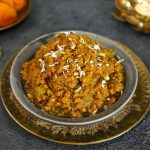
Moong Dal Halwa Recipe
Equipment
- Blender
- Frying Pan
- Heavy Bottom Kadhai
Ingredients
- 1 Cup yellow moong dal (mung bean)
- ¼ Cup almonds
- ½ Cup ghee
- 1 tablespoon gram flour (besan)
- 1 tablespoon semolina (rava/suji)
- 2 Cup full fat milk clarified butter
- ½ teaspoon saffron (kesar)
- 1 teaspoon green cardamom powder
- ⅓ Cup granulated white sugar
- 2 tablesponn almonds + pistachio, sliced
Instructions
- Rinse moong dal until water runs clear. Soak for 1 hour.
- After 1 hour, drain all the water from the dal. Transfer it to a colander to drain all the liquid. Spread it in a single layer on a baking tray lined with a kitchen towel. Put this tray under the fan or sun for 10 - 15 minutes for dal to dry completely.
- Once dal is dry to touch, transfer it to a wide pan. Dry roast over low to medium heat till it is light brown in color (refer to image/video). Keep stirring while roasting. Transfer to a blender. In the same pan, dry roast the ¼ cup almonds for 2 - 3 minutes. Transfer to the same blender as dal.
- Grind roasted dal and almonds to a slightly coarse powder. Transfer to an airtight container to store or use immediately.
- Next, soak saffron and cardamom powder in hot milk. Stir, and keep aside until ready to use.
- To make halwa, heat ¼ cup of ghee in a heavy bottom wide pan/kadhai/casserole
- Add gram flour, semolina, and roast for 2 - 3 minutes or till a sweet, nutty aroma is released.
- Next, add dal badam powder. Mix nicely with ghee. Start roasting it over low to medium flame. After 5 minutes, it starts oozing ghee in the pan and turns deep brown in color. That is your cue to add milk.
- Add in saffron infused milk, and 1 tablespoon of ghee. Continuously stir the halwa to avoid any lump formation and to make sure milk is absorbed by the dal paste. If there is spluttering and bubbling, cover the pan with a lid. Keep it that way for 1 - 2 minutes or till bubbling is settled.
- Once the milk is absorbed by the halwa, add the leftover ghee, and the sliced nuts. Continuously stir and roast the halwa till ghee starts oozing from the sides. This is the signal that moong dal halwa is ready.
- Garnish moong dal halwa with sliced almonds, pistachio, saffron, and edible silver leaf. Serve warm.
Video
Notes
- Divide the ghee into two equal portions to be used at two different stages of cooking halwa.
- Combine hot milk, saffron, and cardamom powder. Do this step at the beginning itself so that the color of saffron is combined with the milk.
- Use fine rava (chiroti rava) and gram flour for this halwa. If you want to keep it gluten-free, skip adding semolina.
- ⅓ - ½ Cup of white sugar is enough for dal halwa. It’s best to taste after adding sugar and if required, add more.
- Use a combination of sliced almonds and pistachio for garnishing the dal halwa. If you prefer, you can ghee roast the nut as well before slicing and adding to the ghee.
- The moong dal halwa tastes best warm straight out of the pan. It remains fresh at room temperature for 4 - 5 hours. Store the leftover in an airtight container in the refrigerator for 1 week. Reheat in a microwave for 5 minutes. This helps melt the solidified ghee. Or you can reheat in a pan with a few full-fat milk or water splashes.
Nutrition
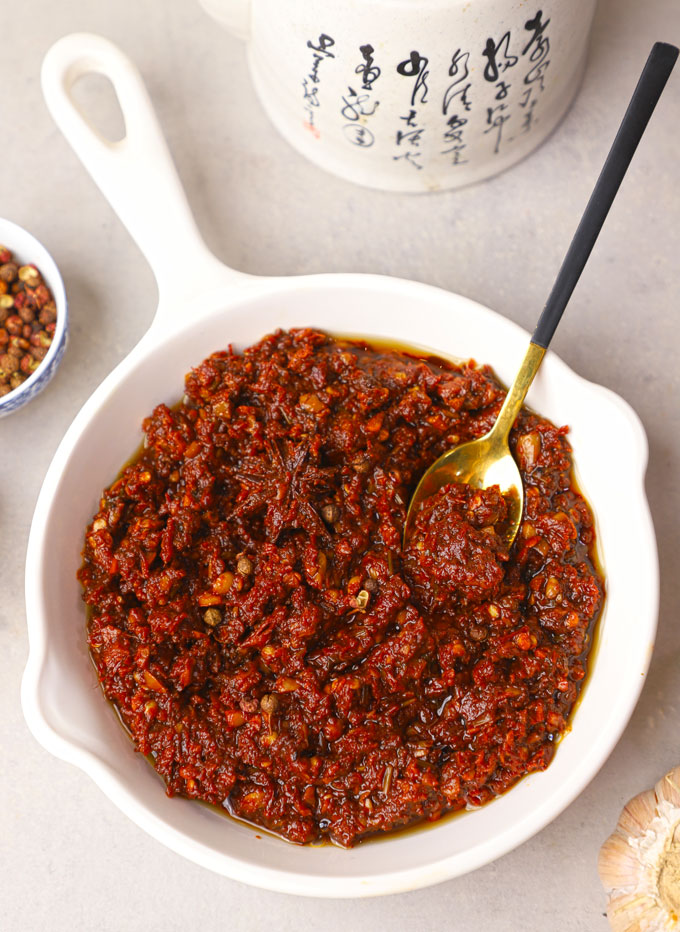
Schezwan sauce, with its bold, fiery flavours, is a quintessential component of Indian-Chinese cuisine. Here is an easy recipe to make the perfect, restaurant-style Sichuan sauce at home.
Estimated reading time: 5 minutes
- Ingredients You’ll Need
- How To Make Schezwan Sauce
- Ways to Use Schezwan Sauce:
- Schezwan Sauce Recipe
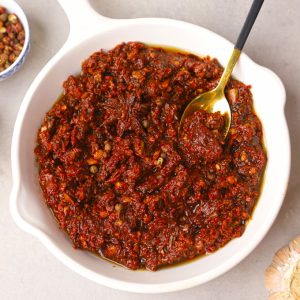
Originating from Sichuan (also spelt as Szechuan) cuisine in China, known for its bold spices, particularly Sichuan peppercorns. Schezwan sauce in the Indian context is a spicy, flavorful condiment used primarily in Indo-Chinese cuisine. It is known for its bold and fiery taste, with a balance of heat, garlic, and tangy undertones.
It’s commonly used to spice up dishes like fried rice, noodles, momo (Tibetan dumplings), stir-fries, and even as a dipping sauce for snacks like spring rolls .
Why You Should Make it at Home
- less sugar makes it a healthier option than store-bought ones.
- easy to customize based on your heat tolerance.
- free from artificial additives and preservatives.
- it is vegan, nut and gluten-free
Ingredients You’ll Need
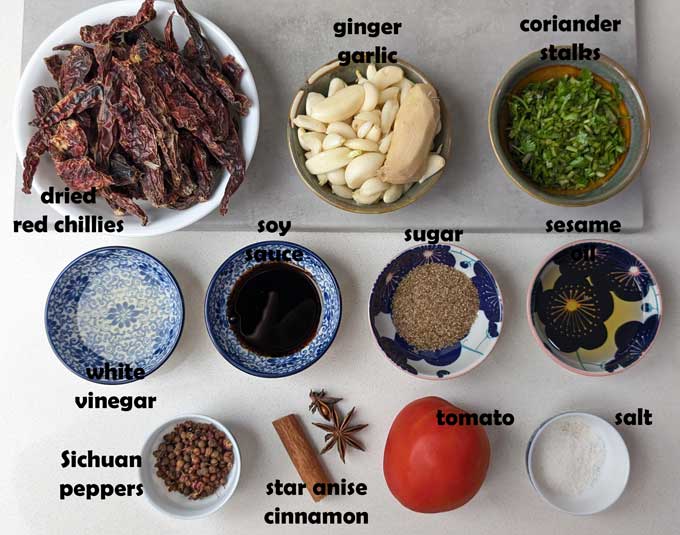
- Red Chillies: The base is made from dried red chillies, preferably Kashmiri which gives the sauce its heat and distinctive red colour.
- Garlic, Ginger , and Coriander Stalks give the Schezwan sauce a pungent taste and aromatic flavour.
- Fresh Tomato is a healthier substitute for tomato ketchup.
- White Vinegar provides acidity and also acts as a preservative.
- Soy Sauce gives it depth and a slightly sweet, savoury taste.
- Sichuan Peppers , also known as Szechuan Peppers . They are native to China, particularly in the Sichuan province, where they are a key ingredient in the region’s famous cuisine.
- Sugar balances the heat of red chillies and peppers.
- Sesame Oil or refined vegetable oil to cook the sauce.
How To Make Schezwan Sauce
Preparing the Chillies:
- De-seed the chillies : To control the spice level, it’s important to remove the seeds. Using scissors or a knife, cut off the stems and shake out as many seeds. If you prefer your Schezwan sauce to be hot, leave the seeds.
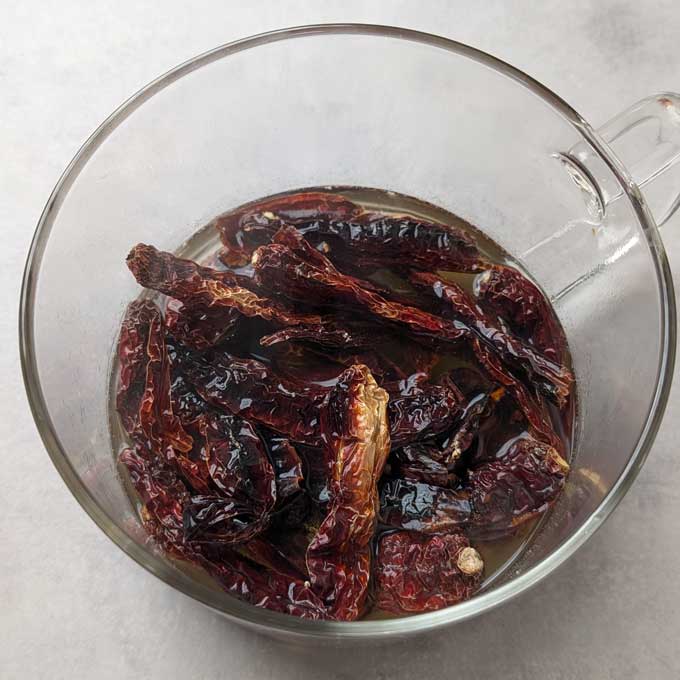
- Soak the de-seeded chillies in hot water for 20-30 minutes. This softens the chillies, making them easier to grind into a smooth paste.
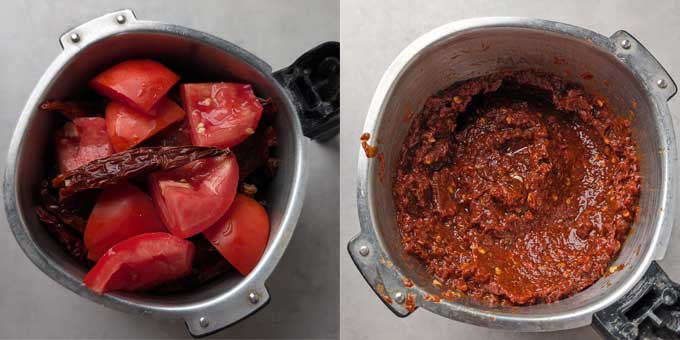
- Grind to a paste : After soaking, drain the water and transfer the softened chillies to a blender. Add about ¼ cup of fresh water, diced tomatoes, and blend into a smooth paste. Keep the paste thick and not watery.
Cooking the sauce:
- Heat Oil in a heavy-bottomed pan. It might seem like a lot of oil, but the oil helps preserve the sauce, enhances its richness, and brings out the flavours.
- Add Garlic, Ginger , and Coriander Stalks once the oil is hot. Sauté this mixture until aromatic. No need to brown them. This step is crucial as it forms the aromatic base of the sauce.
- Add the chilli paste . Be cautious, as the chilli paste might splatter in the hot oil.
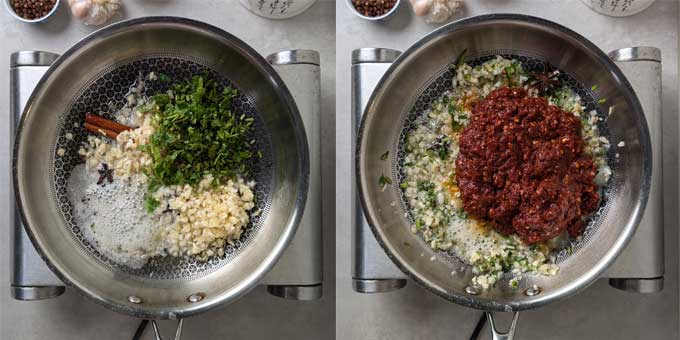
- Stir well to combine , and let the mixture cook on medium heat for about 5 – 6 minutes. You’ll notice the oil separates from the paste, which is a sign that the chillies are cooked properly.
- Season the sauce with soy sauce, vinegar, sugar, Sichuan peppers, and salt to taste. The sugar helps balance the heat and tanginess, while the soy sauce adds a savoury umami flavour that is characteristic of Schezwan sauce.
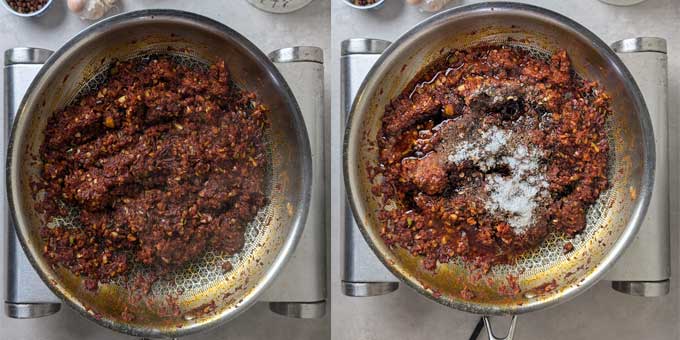
- Simmer the sauce, stirring occasionally. Allow it to cook for another 5-6 minutes on low heat, letting all the flavours meld together.
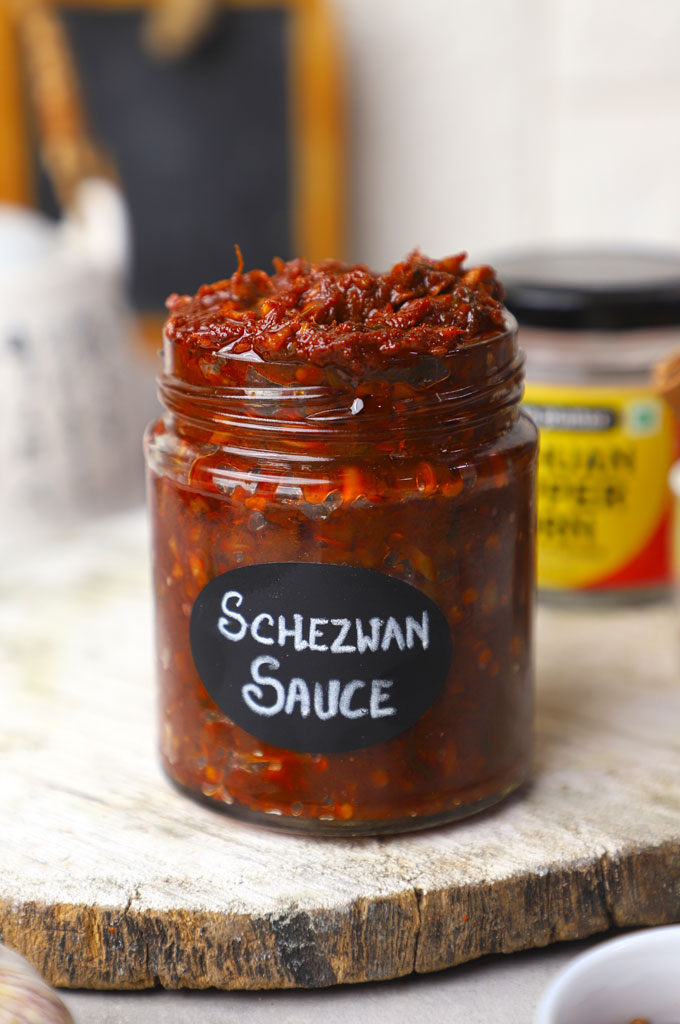
- Check Seasoning : Before turning off the heat, taste the sauce and adjust the seasoning if needed. You can add more salt, sugar, or vinegar-based on your taste preference.
Ways to Use Schezwan Sauce:
- Schezwan Fried Rice : Toss your leftover rice with vegetables, and a generous amount of Schezwan sauce for a quick and flavourful fried rice .
- Noodles : Stir Fry Hakka noodles with veggies for an easy Schezwan noodles recipe.
- Dip for Snacks : Use it as a dipping sauce for spring rolls, momo, or even samosas and pakoras.
- Marinade : Use it as a marinade for paneer, tofu, or chicken before grilling.
- Spread : Spread it on sandwiches, burgers, or pizzas for an extra kick of flavour.
More Sauce and Dip Recipes
- Hummus
- Chilli Oil
- Tomato Salsa
- Garlic Yogurt Sauce
- Spicy Peanut Sauce
- Thai Sweet Chilli Sauce
- Greek Cucumber Sauce
Ingredients
- ▢ 200 gram dried red chillies (preferably Kashmiri Red Chilli)
- ▢ 1 medium size tomato, diced
- ▢ 2 tablespoon minced garlic
- ▢ 1 tablespoon minced ginger
- ▢ 8 – 10 coriander stalks, finely chopped
- ▢ 1 tablespoon light soy sauce
- ▢ 1 tablespoon white vinegar
- ▢ 2 tablespoon light brown sugar
- ▢ 1 teaspoon salt or to taste
- ▢ ½ teaspoon Sichuan Peppers
- ▢ 4 tablespoon sesame oil
Instructions
- De-seed the chillies by cutting and removing the seeds. If you prefer your Schezwan sauce hot, leave the seeds.
- Soak th e de-seeded chillies in hot water for 20-30 minutes. This softens the chillies, making them easier to grind into a smooth paste.
- After soaking, drain the water and transfer the softened chillies to a blender. Add about ¼ cup of fresh water, diced tomatoes, and blend into a smooth paste. Keep the paste thick and not watery.
- Heat oil in a heavy-bottomed pan. Add garlic, ginger, and coriander stalks once the oil is hot. Sauté this mixture until aromatic. No need to brown them. This step is crucial as it forms the aromatic base of the sauce.
- Add the chili paste after the garlic and ginger are well sautéed. Be cautious, as the chili paste might splatter in the hot oil.
- Stir well to combine everything, and let the mixture cook on medium heat for about 5 – 6 minutes. You’ll notice the oil separates from the paste, which is a sign that the chillies are cooked properly.
- Season the sauce with soy sauce, vinegar, sugar, Sichuan peppers, and salt to taste.
- Before turning off the heat, taste the sauce and adjust the seasoning if needed. You can add more salt, sugar, or vinegar-based on your taste preference.
- Once the Schezwan sauce is cooked, let it cool completely before transferring it to an airtight container.
Recipe Notes:
- Storing the Sauce: Schezwan sauce can be stored in the refrigerator for up to 3-4 weeks, thanks to the oil and vinegar, which act as natural preservatives. Just make sure to use a clean, dry spoon each time to extend its shelf life.
- It might seem like a lot of oil, but the oil helps preserve the sauce, enhances its richness, and brings out the flavours.
- If you want to make it a little saucy, add vegetable stock instead of water while simmering the sauce.
- Substitute Schezwan peppers with white peppers for a mild peppery flavour.
Nutrition
We follow a strict NO SPAM Policy
